Russell and Hays, KS Seminar – Day One
Wednesday, February 18, 2026
Submitted by: Dena Bunnel
KARL Class XVII’s final domestic seminar found us starting our day in Russell, Kansas, the hometown of our very own Mike Parsons.
Andrea Krauss (Class XVI) led us on a tour of a new apartment development project just off Main Street, which will provide 20 moderately priced apartment units targeted at young professionals through the renovation of the historic Hotel Holland. The BrickStone Lofts project provides a perfect example of the persistence and grit required to make economic development happen – the project has been made possible through a combination of state funds, grant dollars and private fundraising, and an immense amount of time, detail and passion by Krauss.
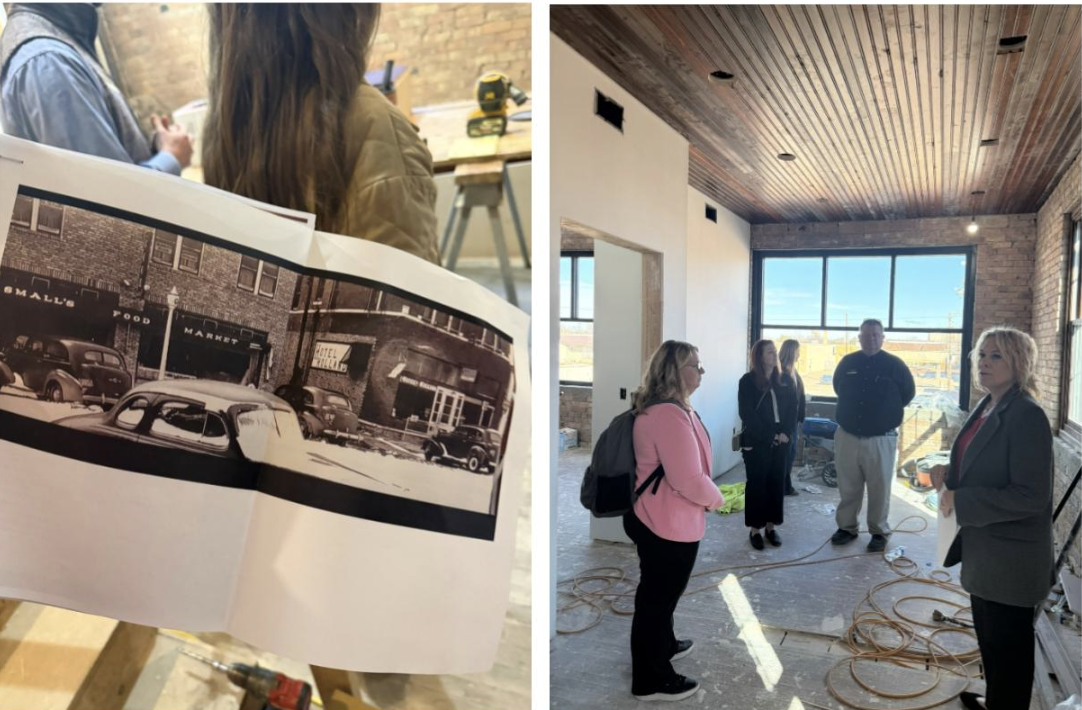
Old and new: a photo of the historic Hotel Holland as it is being converted into the BrickStone Lofts.
Andrea next led us down Main Street to the new I.D.E.A. Works maker’s space which will provide a variety of services that include welding, laser cutting, sewing, quilting and a commercial kitchen. Also funded through a mix of grant funding and private donations, the space provided a peak into a bright future for downtown Russell.
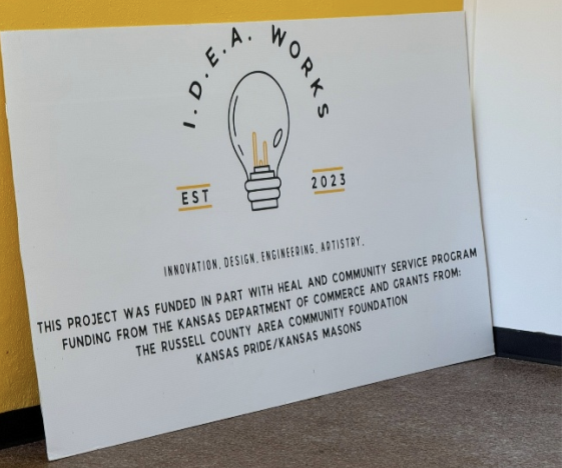
The sign for I.D.E.A. Works maker’s space, just waiting to be hung.
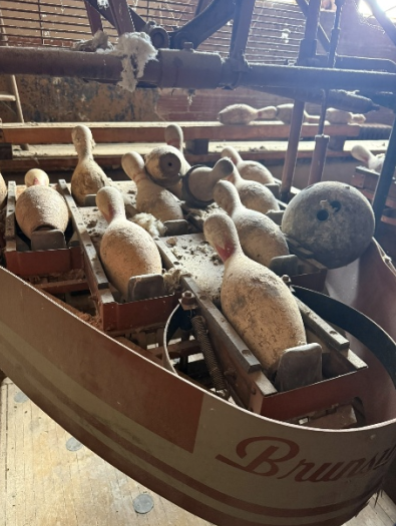
To round out our morning tour, we also got the chance to sneak up to the old second floor bowling alley where Bob Dole himself was once a pin boy.
By noon the whole class had gathered at the Deines Cultural Center for a traditional German lunch and a series of presentations related to the oil and gas industry in Kansas. Warren Martin, executive director of Kansas Strong: The Kansas Oil and Gas Resources Fund, presented on the outsized role of the oil and gas industry to Kansas, as well as the rest of the world. A particularly striking statistic that he shared is that 96 percent of the objects that we touch rely on petroleum in some way. He also highlighted that the oil and gas industry supplied 7.5 percent of non-agricultural jobs in Kansas, resulting in an $8.66 billion economic impact.
With an understanding of the large role that the oil and gas industry plays in Kansas, Matt Dreiling next showed us how to find it. As Vice President and geophysicist at John O.
Farmer, Inc., which is based in Russell, Dreiling helps the company determine where new drilling should take place using advanced technologies like 3D Seismic that can show where underground hills are located. This is important because in an underground reservoir, oil and gas will rise above the water, and so these buried hills provide an indication of where oil and natural gas reserves can be found. However, at about $35,000/square mile, this sonogram-like technology must be used strategically.
The class next travelled to an oil well site to see the crude oil production process in action and learn from John O. Farmer IV, President of John O. Farmer, Inc. Farmer started with a quick lesson in the geological history of Kansas, from the glaciers that covered the Flint Hills hundreds of thousands of years ago to the ancient underground Arbuckle rock formation that much of the Kansas oil and gas industry centers upon. Farmer then explained the process of drilling a well, pumping the oil, recycling the water back into the reservoir and how an oil lease and mineral rights work for a landowner. Farmer also shared some of the challenges in this field, including a shrinking industry that led the company to diversify its operations, and the realities of having to self-insure their wells and tanks due to some of the associated risks of the business.
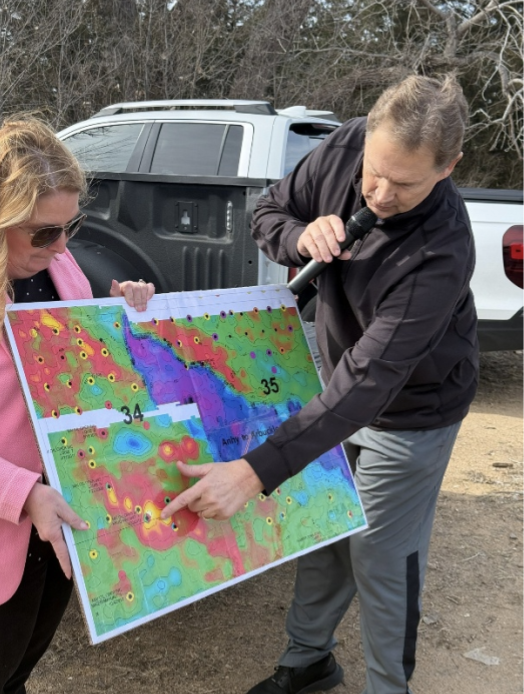
John O. Farmer IV explaining 3D Seismic mapping for well site identification.
KARL Class XVII next headed west towards Hays, making a brief pitstop to see the impressive “Cathedral of the Plains” Basilica of St. Fidelis in Victoria, Kansas, one of the 8 Wonders of Kansas.
Reconvening at the Lb. Event Center in downtown Hays, the class turned its attention to a major challenge for rural communities, especially during a difficult farm economy: mental health. Will Stutterheim, psychology instructor and undergraduate apprenticeship coordinator at Fort Hays State University, shared about what is happening in our brains when we experience high stress situations. Together with Sarah Gideon, executive director of the Health Innovations Network of Kansas, our group learned some tools to look out for signs of mental health stressors in our neighbors, families and friends, and resources available to get or recommend help. You can find these resources on the Health Innovations Network of Kansas website: https://www.healthinnovationsnetworkofkansas.org/hink-spin. If you or a loved one are experiencing an emergency event, people can reach the national suicide and crisis lifeline by call or text 988 or online chat at 988lifeline.org.
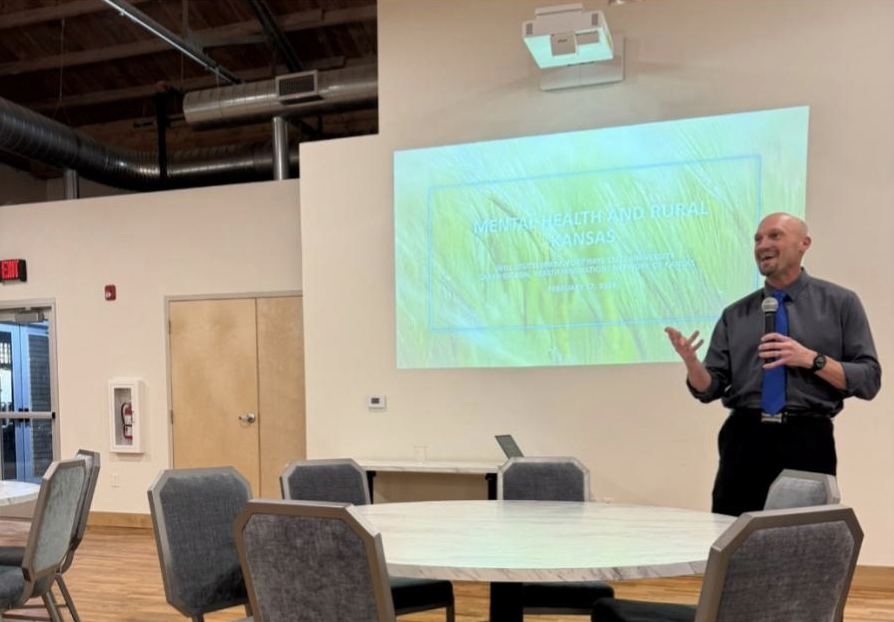
Will Stutterheim shares how he started out trying to reach farmers managing stress.
Hays, KS Seminar – Day Two
Thursday, February 19, 2026
Submitted by: Clint Glaser
The second day of our Hays seminar began with a trip to STEM Harvest. Our first presenter was Ben Shears.
Ben Shears: Vice President for Economic & Workforce Development
Fort Hays State University (FHSU)
Background & Role: Ben Shears recently transitioned into his role at FHSU after serving nine years at Northwest Tech. He described his position as serving as the “front door” between Fort Hays State University and Kansas businesses—particularly those in western Kansas. His focus is building relationships and connecting industry needs with educational resources.
He emphasized that despite technological advancements, relationship-building remains foundational: “Nothing replaces a handshake.”
Institutional Partnerships & Pathways: FHSU is strengthening and expanding its technical education pipeline through institutions that are now officially part of FHSU:
These technical colleges are integrated with FHSU and provide structured pathways for students to continue from technical programs into four-year bachelor’s degree programs.
Key career pathways currently emphasized:
Future development areas include agriculture—particularly potential ag technology programs—though leadership is still defining where FHSU best fits within the agricultural education space. There are also plans to increase outreach and engagement in southwest Kansas.
Banking & Rural Financial Workforce Development: FHSU offers a 12-hour Banking Certification Program designed to enhance the skills of current bank employees and support professional growth and advancement within banks.
Shears is collaborating with:
The focus is addressing rural banking challenges, including the shortage of local lenders, workforce gaps in small community banks, and long-term succession planning within rural financial institutions.
Observations on Current Students (Generation Z)
These generational traits are influencing workforce development strategy and program design.
Small Business & Succession Planning: Shears works closely with the FHSU Docking Institute and the Kansas Small Business Development Center (SBDC). A significant concern identified is the lack of succession planning among rural Kansas businesses. He views business transition and ownership continuity as one of the most pressing economic development challenges in western Kansas. Efforts are underway to strengthen collaboration with the SBDC and improve long-term small business sustainability strategies.
Our next presenter was Dr. Grady Dixon
Dr. Grady Dixon: Professor & Dean
Werth College of Science, Technology, and Mathematics
Fort Hays State University (FHSU)
Background: Dr. Grady Dixon serves as Professor and Dean of the Werth College of Science, Technology, and Mathematics at Fort Hays State University. He is a weather researcher whose academic work has focused on severe storms, tornado patterns, and the intersection of weather and human health.
Tornado Research & Industry Response: While at Mississippi State University, Dr. Dixon and a graduate student conducted research examining tornado duration and intensity patterns in the southern United States, particularly Mississippi.
Their findings challenged conventional assumptions that the most severe and long-lasting tornadoes primarily occurred in traditional “Tornado Alley” states such as Kansas and Oklahoma. Instead, their research showed that tornadoes in Mississippi and other southern states often:
The study was published in April 2011 and was met with considerable industry backlash. Despite resistance, Dr. Dixon chose to publish because it served the public good and improved awareness in high-risk regions.
Weather & Mental Health Research: Dr. Dixon also examined correlations between weather patterns and mental health outcomes. He found consistently higher rates of mental health struggles and suicide during periods of unseasonably warm or unusually hot weather.
Leadership & Community Themes: Dr. Dixon emphasized leadership principles centered on community impact:
Dixon’s presentation was followed by Jason Klindt, Senior Director of External Affairs at Evergy
Service Territory: Jason Klindt discussed Evergy’s service footprint, which primarily covers eastern Kansas, with portions extending into western Kansas. Evergy serves a significant share of Kansas’ population and industrial base.
Energy Generation Shift: Klindt explained how Evergy’s energy generation mix has evolved over time.
Current Projects: Evergy currently has six major projects in development, including five projects in Kansas and one solar project outside Kansas.
These projects are designed to enhance reliability, capacity, and long-term system flexibility.
Data Centers & Public Perception: Klindt addressed misinformation and communication gaps surrounding data centers. He emphasized several potential benefits associated with data center development:
He also noted that Evergy’s rate changes remain among the lowest compared to neighboring states, reinforcing Kansas’ competitive positioning for industrial growth.
Mike Morley, Director of Corporate Communications & Government Affairs at Midwest Energy followed.
Organizational Overview: Mike Morley discussed Midwest Energy’s service footprint and operational focus. The organization serves approximately 40 counties, primarily across western Kansas. Midwest Energy plays a significant role in rural electric and energy infrastructure throughout the region.
Energy Policy & Market Shifts: Morley noted recent federal policy shifts impacting energy procurement, including increased emphasis on domestic coal generation. These shifts reflect broader discussions about energy security, domestic production, and grid reliability.
Wind & Renewable Energy in Kansas
Aging Infrastructure & Cost Pressures: Aging assets such as distribution lines, transmission lines, and substations present a major challenge. Many are reaching replacement age, and replacement costs have increased significantly due to inflation and supply chain pressures.
Electric Vehicles (EVs)
SPP’s Integrated Marketplace (Slide Highlights): The SPP (Southwest Power Pool) Integrated Marketplace governs how wholesale electricity is bought and sold across the region.
Integrated Marketplace: Participants buy and sell wholesale electricity in both day-ahead and real-time markets.
SPP
1) A power company with a peak load of 100 MW must secure generation capacity of approximately 115 MW.
2) The power company bids its generation at operating cost into the Day-Ahead Market.
3) SPP dispatches the most cost-efficient generation to meet load and sets real-time prices in 5-minute increments.
4) The power company pays real-time price for power at one of 527 trading hubs, with settlements issued monthly via check or invoice.
Nikki Pfannenstiel, Economic Development at Sunflower Electric Power Corporation, then provided an overview of Sunflower Electric Power Corporation’s history and cooperative structure. Sunflower was formed in 1957 when six western Kansas distribution cooperatives joined together under the cooperative business model to provide wholesale energy. The organization operates not solely for profit, but with a focus on serving Kansans and supporting rural communities and their way of life. Sunflower primarily serves western Kansas.
Organizational Statistics
These figures reflect the scale of infrastructure required to serve rural western Kansas across a large geographic footprint.
Energy Mix & Generation Trends
The shift reflects broader industry trends toward renewable integration while maintaining reliability for member cooperatives.
Energy Panel Discussion
Mike Morley – Midwest Energy; Jason Klindt – Evergy; Nikki Pfannenstiel – Sunflower Electric Power Corporation
Continued Energy Network Expansion
The panel emphasized the ongoing need to expand and modernize Kansas’ energy infrastructure. Continued investment in generation and transmission capacity is necessary to meet future load growth and maintain long-term reliability.
Data Centers & Public Communication
Data centers were a major topic of discussion. Panelists noted that misinformation and communication gaps have contributed to public concern. They emphasized several economic benefits of data center development:
They stressed the need for clearer communication regarding how data centers operate and their broader economic contributions.
Water Use Considerations
Water usage concerns were addressed, particularly in western Kansas communities.
Battery Storage & Emerging Technology
Transmission Lines & Landowner Relations
Panelists discussed how utilities approach negotiations with landowners when installing transmission lines.
Solar Development Trends
Utility-Scale Solar:
Residential / Small-Scale Solar:
Dallas Haselhorst- Stem Harvest
Organization Overview: Dallas Haselhorst presented on Stem Harvest, a nonprofit organization founded in 2023. Stem Harvest’s mission is to create an environment where area youth can develop technology-related skills, including programming, prototyping, 3D printing, robotics, and applied coding skills.
Facility Development: Haselhorst discussed the acquisition and renovation of the former Hays Daily building, which now serves as Stem Harvest’s headquarters. The building renovation was supported by community partners, state-level support, donors, and grants.
Workforce & Education Gap: A major theme was the growing demand for STEM (Science, Technology, Engineering, and Math) occupations in the region.
Strong regional demand for STEM-related careers.
Many high school graduates are not adequately prepared for college-level STEM majors.
Need for earlier exposure and applied skill development.
Stem Harvest aims to help close this preparation gap by providing hands-on learning opportunities outside traditional classrooms.
Programs & Community Engagement:
They offer adult classes, including introductory AI and technology training designed to support small businesses.
Current meetups include:
Stem Harvest is also involved in the Hays Science Festival.
Expansion & Future Plans
Additional technology-focused initiatives
Stem Harvest is affiliated with RISE, a launchpad supporting the next generation of Kansas entrepreneurs. Through RISE, students are given opportunities to develop products, sell items, and gain real-world entrepreneurial experience.
Stand and Deliver
Thursday afternoon, we each stood in front of the class and shared a 3–5-minute speech about our KARL experience. We talked about what we’ve learned, what challenged us, what impacted us most, and how we plan to use these experiences as leaders moving forward.
Everyone was incredibly open and honest. The room was filled with emotion — happiness, sadness, encouragement, laughter, and even tears. It was a powerful reminder of how much this program means to each of us and how much we truly value the time we’ve spent together.
More than anything, the speeches showed how much we have grown — both individually and as a class. It’s clear that what we’ve built through KARL doesn’t end here. The growth, relationships, and leadership lessons will carry forward. The future is bright for KARL and for this group, and I’m excited to see what we accomplish next.